Understand your numbers
BMR vs TDEE: The Difference and Which Number to Use
BMR vs TDEE explained with clear diagrams and a worked example. Compare activity estimates, avoid double-counting, and try the free BMR calculator.
By SolviqLab Editorial Team · · 9 min read

The short answer
BMR estimates energy use at rest. TDEE estimates energy use across your whole day, including activity. Use BMR to understand the resting component and TDEE to explore daily expenditure. Neither number alone is a personalised eating plan.
Try the FREE BMR calculator →BMR vs TDEE: the difference in one minute
Your calculator says 1,408 calories a day. Another gives 2,182. Before choosing either as a food target, check what the number actually includes.
BMR means basal metabolic rate: energy used to support basic functions under strict resting conditions. TDEE means total daily energy expenditure: energy used across the day, including resting metabolism, physical activity and processing food. An online calculator estimates these quantities; it does not measure your metabolism.
| Your question | Useful starting point | What to remember |
|---|---|---|
| How much energy might my body use at rest? | BMR estimate | It leaves out part of a normal day's energy use. |
| How much energy might I use over a whole day? | TDEE estimate | The result depends on the activity assumptions. |
| How much should I personally eat? | Daily expenditure plus individual context | A calculator alone cannot assess a suitable eating plan. |
TDEE already includes resting energy. Do not add BMR to TDEE. The two numbers describe a part and a total, not two separate calorie allowances.
Start with the free BMR calculator. If you already understand your resting estimate, move to the TDEE calculator to explore activity.
What TDEE includes beyond BMR
Think of BMR as one part of a larger total. Daily energy expenditure also includes moving around, exercising and processing food. A day without a gym session still includes energy use beyond resting metabolism.
The FAO/WHO/UNU report on human energy requirements describes these components and distinguishes a population estimate from an individual's needs. There is no single fixed percentage split that applies to everyone.
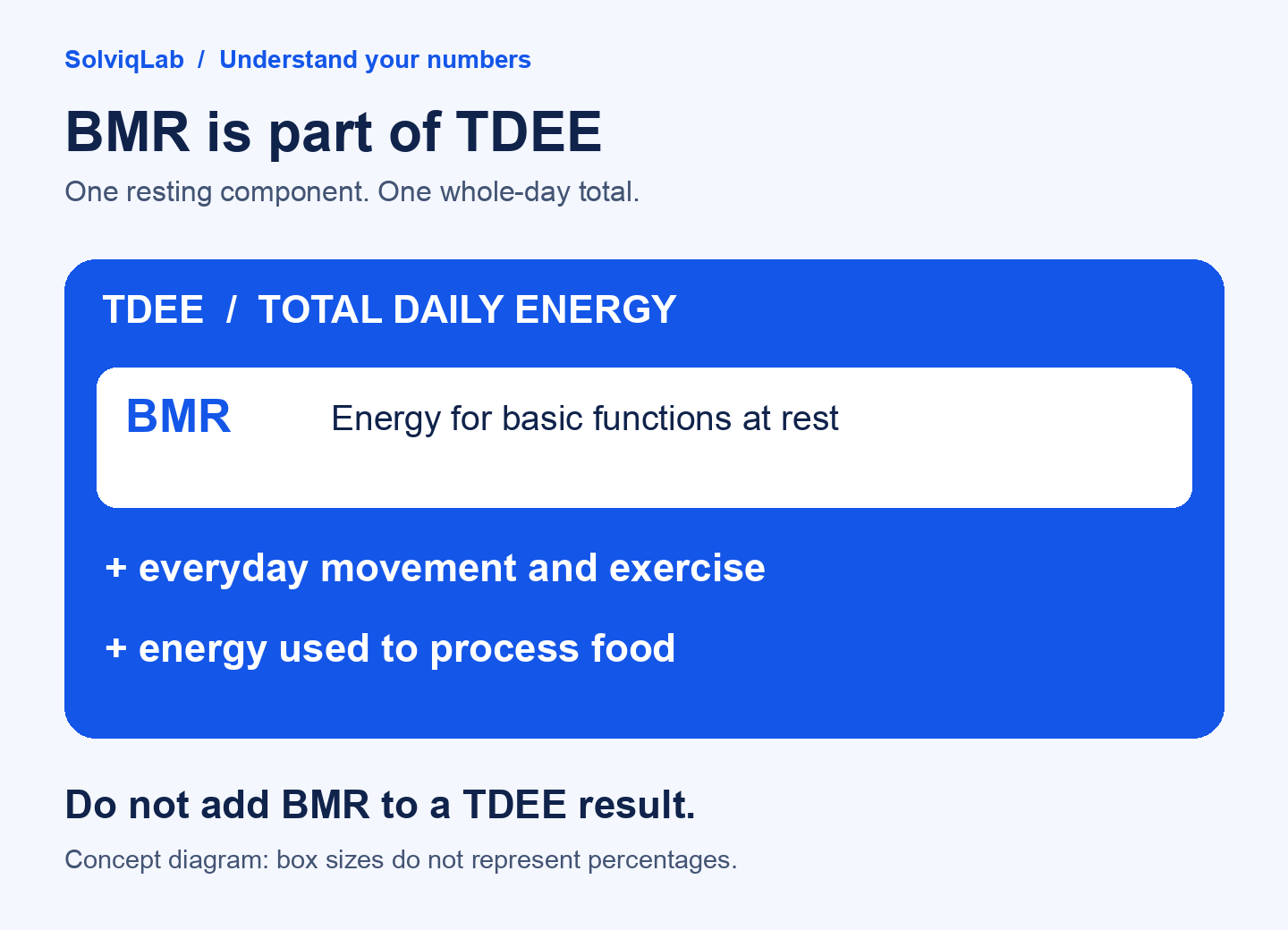
BMR is inside the total, not an extra allowance to add to it. The diagram is conceptual; the sizes of the boxes do not represent measured proportions.
A BMR calculation example you can reproduce
We use one illustrative adult throughout the guide: 35 years old, 70 kg, 167 cm, with the female coefficient selected. This is a worked example, not a customer testimonial or a recommended diet.
The simplified Mifflin–St Jeor equation gives:
10 × 70 + 6.25 × 167 − 5 × 35 − 161 = 1,407.75 kcal/day.
Our BMR calculator rounds this to 1,408 kcal/day. Enter those four values to check the result. Select metric units so kilograms and centimetres are interpreted correctly.
The male coefficient in this equation is +5 instead of −161. These coefficients come from the model; they do not capture every difference in body composition or physiology.
The original Mifflin study predicted resting energy expenditure. Consumer tools commonly label the result BMR, but a predicted resting value is not a laboratory measurement of basal metabolism. A detailed explanation of the measurement conditions is available from Cleveland Clinic.
How BMR becomes a TDEE estimate
A common calculator approach is:
Estimated TDEE = estimated resting energy × activity factor.
Here are three outputs from the SolviqLab TDEE calculation, using the same person and changing only the activity selection:
| Activity selection in our tool | Calculation using rounded BMR | Estimated TDEE |
|---|---|---|
| Sedentary | 1,408 × 1.2 | 1,690 kcal/day |
| Lightly active | 1,408 × 1.375 | 1,936 kcal/day |
| Moderately active | 1,408 × 1.55 | 2,182 kcal/day |
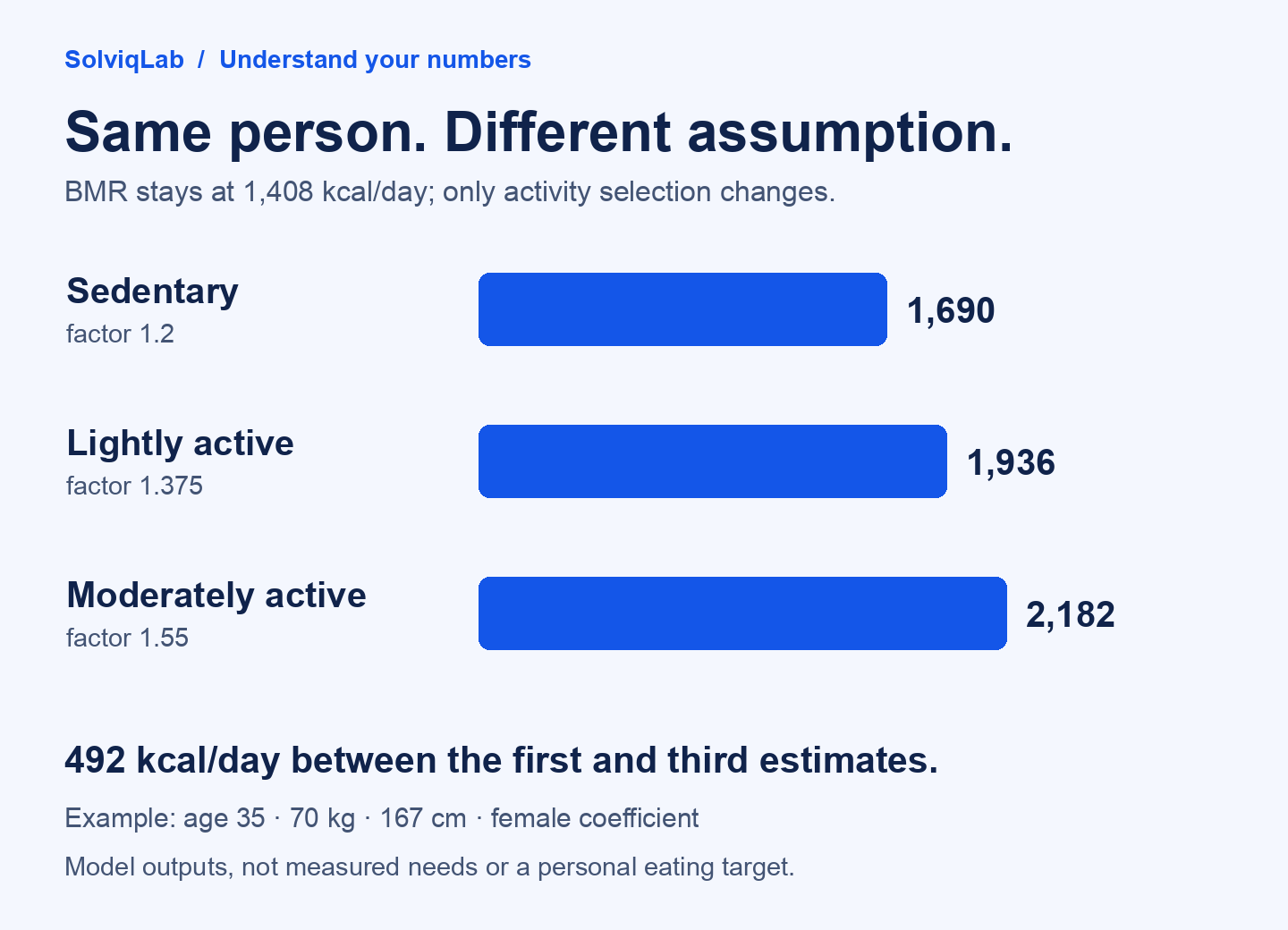
Illustrative calculator outputs for the same adult, not measured energy needs or an individual eating prescription. The bars start at zero; exact results are also given in the table above.
The first and third selections differ by 492 kcal/day. The person did not change. The assumption did. The table demonstrates sensitivity to that assumption; it does not establish which category describes you.
Our TDEE calculation rounds resting energy before applying the multiplier. A calculator that keeps 1,407.75 until the end would show 1,689 for the first row. A one-calorie rounding difference is not meaningful precision about a human body.
The activity factors belong to the daily-energy calculation. They are not part of the original Mifflin resting-energy equation. You can reproduce the table in the free TDEE calculator.
Does activity mean only exercise?
No. A whole-day estimate also needs to account for ordinary movement: walking, work, household tasks and other routine activity. Two people with the same gym schedule may spend the rest of their week very differently.
The FAO/WHO/UNU discussion of adult energy requirements considers habitual activity across the day. Our dropdown is a simplified model, not a measurement of each task. Read the option descriptions in the tool; a label used by another calculator may use a different multiplier.
Should you use BMR or TDEE for a calorie target?
TDEE is the more relevant starting estimate for whole-day energy needs. BMR alone does not answer how much to eat. A calorie target is a separate decision that also depends on your goals, nutritional needs and health circumstances.
A maintenance-calorie estimate aims to describe intake associated with maintaining weight over time. It is commonly based on estimated TDEE. That does not make a calculator's maintenance number an exact measurement or a guarantee of stable weight.
Should I eat my BMR to lose weight?
A BMR result is not a ready-made weight-loss prescription. It leaves out some daily expenditure and provides no assessment of whether a particular intake meets your needs. Equally, an online estimate cannot establish one universal boundary between safe and unsafe diets.
Avoid automatically subtracting a fixed amount from your BMR. If a tool displays weight-change targets by applying a fixed offset to TDEE, those are calculation scenarios, not a personalised assessment of suitability.
For a personal eating plan, a registered dietitian or another appropriate healthcare professional can interpret your circumstances. The NIH Body Weight Planner provides a separate model for exploring calorie and activity changes over time; it is designed for adults and excludes pregnancy and breastfeeding.
Why do calorie calculators give different results?
Before comparing totals, run this short check:
| Check | What to compare |
|---|---|
| Result label | Is one number resting energy and the other a daily total? |
| Inputs and units | Are age, formula coefficient, weight and height actually identical? |
| Resting equation | Is each tool using Mifflin–St Jeor, or a different model? |
| Activity assumption | Does the same label use the same multiplier? |
| Rounding | Does it round BMR before calculating the daily total? |
| Extra additions | Does the method already include the exercise you are adding separately? |
For the last row, read the tool's method. Adding a workout again can count the same activity twice if it is already represented in the daily estimate. It is an accounting check, not a reason to ignore exercise.
Compare like with like before deciding a tool is wrong. Matching calculator outputs still does not prove they match your individual energy expenditure.
How accurate are BMR and TDEE estimates?
A formula can return a precise-looking integer while remaining uncertain for an individual. Its usefulness is as a starting estimate with visible assumptions.
A systematic review of resting-energy prediction equations found Mifflin–St Jeor comparatively reliable among the equations examined. It also identified individual errors and underrepresentation of some age and ethnic groups. The finding does not mean every person's result is accurate to within 10%.
TDEE adds another assumption about activity. The 492-calorie spread in our example shows why the selected activity category deserves attention; it is not a statistical confidence interval.
A low calculated number cannot diagnose a damaged metabolism. If there are symptoms, medical concerns or a need for clinical nutrition planning, seek appropriate professional assessment. A clinician can advise whether measured resting energy expenditure is useful.
This guide is general information for adults. It does not provide an eating plan for children, pregnancy, breastfeeding, eating-disorder recovery or medical conditions requiring individual nutrition care.
What to do with your result
- Calculate resting energy. Use your own inputs in the free BMR calculator, and check the units.
- Label the number. Record it as an estimate of resting energy, rather than your daily food allowance.
- Explore daily expenditure. Open the TDEE tool when you need to include activity, and check the assumptions behind your selection.
- Keep the question specific. For example: “Does this total already include my activity?” is more useful than treating every calculator number as interchangeable.
- Choose suitable support. Use professional advice for individual medical or dietary decisions. Optional AI coaching can help you organise everyday questions and next steps within the product's capabilities.
The BMR calculation is free and does not require an account. If you want to explore additional support, Mia is our AI coach. Coaching is a separate, optional product with its own access conditions; Mia is not a clinician.
Quick answers
Is BMR the same as maintenance calories?
No. BMR concerns resting energy. A maintenance estimate concerns the whole day and is generally based on estimated TDEE. Neither is measured simply by entering your details into a calculator.
Why is my TDEE higher than my BMR?
A daily total includes energy costs beyond the resting component. The size of the gap in a calculator depends on the selected method and activity assumptions.
Is BMR the same as RMR?
Basal metabolic rate and resting metabolic rate are related, but their measurement conditions differ. Our tool uses a predictive resting-energy equation commonly presented as a BMR estimate; it does not perform either laboratory test.
Do I add BMR to the TDEE result?
No. BMR is already part of the total. Adding it again would double-count the resting component.
Start with your own estimate
Use the free BMR calculator to understand the resting-energy part of the picture. Then explore daily activity separately.
Open the FREE BMR calculator →Sources & editorial notes
- Mifflin et al. (1990): A new predictive equation for resting energy expenditure
- Frankenfield et al. (2005): Systematic review of resting metabolic rate equations
- NIDDK: About the Body Weight Planner
- Cleveland Clinic: Basal metabolic rate — meaning, measurement and limitations
- FAO/WHO/UNU: Human energy requirements — principles and definitions
- FAO/WHO/UNU: Human energy requirements — adults
Prepared with AI assistance. Worked-example values reproduced in the SolviqLab calculators; conceptual diagrams are original explanations, not individual measurements. Additional FAO/WHO/UNU sources checked on 6 October 2026; earlier references reviewed on 5 October. No independent clinician review is claimed. Educational information, not personalised medical or dietary advice.
Our editorial policy